The Turnip Truck

There sure are a lot of bumps on the road to spiritual enlightenment.  Aside from all the bumps that led me to this road in the first place, that is.  I think I need handlebars.

First of all, I am very bad at keeping a meditation practice.  It’s not because I can’t meditate given the time.  It’s because by the time I’ve come home from work and done my various chores I am ready to sleep.  (Okay, I confess I did pick up a murder mystery that I couldn’t resist this week.)   But generally I am quite earnestly unable to stay awake past 9 pm, which is just about the time I finish settling the kids and house.

So I’m not approaching my desired state of peaceful equanimity at the pace I would like.  Still, I am making progress.  This weekend was a case in point.  I went to see a girlfriend on Saturday night.  We had a splendid little party in her very pretty backyard, making much of her Rose and tapenade.  I drank too much.   That is points away from my goal if I am keeping score, which I am not, exactly, but may be informally doing, even though that is silly and not helpful.  Still, I recovered myself and proceeded to avoid my usual self-depracations after a night of over-indulgence.  That does not really amount to points recovered since I’m supposed to avoid alcohol if I wish to cultivate clarity. All the same, I gave myself a pat on the back for not berating myself for my immaturity for more than a moment or two.

But, in trying move beyond a morning yoga routine and some rather undisciplined efforts at self-awareness to a regular meditation practice I’ve hit a bump.  From here the bump looks like a lack of time and energy resources but something tells me its more to do with my priorities.   So, as I near the end of my current commute-enhancing audio book (David Copperfield which, narrated by Simon Vance is brilliant and I heartily recommend) I’ve picked up Jack Kornfield’s Buddhism for Beginners.  My idea is that compassion and a disciplined state of mind pursued with dogged (if inconsistent) determination will deliver me from my usual unhappy state of crabbiness.

And we will see where this turnip truck takes me.  Even if I get tossed off the back after hitting a pot-hole I’ll have arrived somewhere new, I think.

Meantime, I’m working on another story (children’s, this time) and getting some really swell feedback on The Seventh Sister, which I am very grateful for.  And I will sign off to meditate (at least until I fall asleep).

In peace.

Leave a comment

Filed under Uncategorized

what happened

In all my years of contemplating people, their sameness, their differences, their common experience of emerging from a womb, I had never truly developed a philosophy that allows me to accept people as I find them when I find their values at variance with my own.  This failure has always been a source of anxiety for me.  My ideal for myself is to cultivate some form of equanimity.  And I’ve known for a good long time that going about my life in a state of annoyance with other people – and with myself – was somehow falling short of the mark.

The whole point of studying comparative religions was to arrive at an understanding of people, despite differences of belief, perception, and culture.  And yet I had to own up to a failure to achieve even a simple understanding and acceptance of people who I share a society with but can’t sympathize with religiously, politically, or ethically.  I tried to look at things from other people’s perspectives but found that ultimately my beliefs were my beliefs.  As green as it sounds I believe in fairness and honesty, in generosity and decency, in tolerance, in manners and kindness, and was finding it increasingly difficult to forgive the blatant violations of those values I saw around me.  And I wasn’t very happy with myself, either, for not only failing to develop a working philosophy but for my own lack of patience and skill.  Where was my equanimity?   I was – and I knew I was – calcifying.

Until I read – really read and digested – the Dalai Lama’s book.

The first thing I learned:  Everyone wants to be happy.  In that way we are all the same.  I may believe that a person’s motives and actions are “wrong,” but I can accept that we are the same in that we both wish to be happy and I cannot fault a person for wanting the same thing that I do.   Well I could, but it wouldn’t make much sense to.

I found that idea helpful because this thought helps me to refrain from being judgmental.  I have an obnoxiously judgmental frame of mind.  I can barely stand myself.  Without meaning to, I evaluate and pass judgment on every little thing that comes under my nose- including myself.  But with this new lesson, when I feel the urge to condemn someone for unkindness or greed or selfishness I remind myself that their wish is to be happy, no more or less than myself,  and this pacifies me.  Conversely I forgive myself for my wish to be happy because I am like everyone else in this respect.  At least temporarily, the judgement goes away.  This was a HUGE leap for me.  Before attaining this little weapon of the mind I would remain offended with people’s behaviors or stew over my own failures.  But the thought that we are seeking happiness – however misguided I may believe us (others or myself) to be – allows me to dismiss my judgement.

This goes a long way toward helping me cultivate patience.   I am still working on remembering this principal in critical moments. But eventually I do remember it, even if I’ve already set my head on fire with some annoyance or other, and I manage to calm myself.

The next thing I learned was that I can cultivate happiness inside my mind, quite apart from the circumstances I find myself in.  This has a huge potential for happiness.  For years I have chased happiness in the form of creating situations or accomplishing tasks.  But none of the situations I’ve created or tasks I’ve accomplished have succeeded in bringing me happiness.  Satisfaction, yes, perhaps … but not any sort of lasting happiness.  Masters degree, marriage, kids, home, garden, career, novel … pah.   And yet, a simple act of self forgiveness and releasing judgment inside of my mind has brought me more happiness than any of my most hard-earned accomplishments.  Not that my calcifying mind was putty in my hands, but the prospect of creating happiness within the confines of my mind is better than setting off on another achievement adventure.  They say the definition of insanity is repeating the same behaviors and expecting different results.  So I deemed the change of direction a promising thing.  Which brought me knocking at the door of compassion practices, as a matter of course, according to the Dalai Lama.

The Dalai Lama writes eloquently about compassion and its many practical virtues.  I will allow those to speak for themselves, but a cursory and simple application of his principals led me to several much happier days – all in a row – and to open a book that claims to elucidate the path of Thibetan Buddhism …

The afore-mentioned opens with a prayer:

I take refuge in the buddha, the dharma, and the spiritual community

until I attain the state of enlightenment …

By then it was an easy and natural step to the concept of refuge because I found myself wishing to take refuge from my own thoughts, which I had become aware was causing me to feel unhappy and anxious.  A steady stream of thought chatter – mostly vapid, from what I could tell –  which I fancied resembles a group of monkeys taken together in a fit of excitement, was not contributing to my ability to empathize with other people or to relax.  It was not enabling me to accomplish my goals.  And I wanted to turn it off.

So I took the Dalai Lama’s advice again, and I took refuge … which led me to another door.

2 Comments

Filed under Uncategorized

The Goddess, The Buddha, Adulthood.

It’s been 8 years since I wrote a thesis exploring models of reality as presented by a then-controversial 2nd century Gnostic Christian and an important Buddhist thinker who was his contemporary.

All the while, books exploring the nature of reality, the nature of the mind, treatises on the human condition and meditation, religious texts, and religious philosophy from Buddhist, Islamic and Christian perspectives rested, undisturbed, on my book shelves.

As a matter of habit I explored spiritual training in esoteric fields, blending the study of goddess-based spirituality with my role as a mother.  I’d always had a strong leaning toward earth-based religious philosophy for its vividness and common-senseness.  I’m an avid environmentalist – at least in principal if not always in action – and found that the philosophies of wicca were a natural match for me, values-wise.  But somehow I wasn’t reaching into myself, wasn’t improving, and wasn’t feeling peace.

I gazed longingly at my book shelves.  During my studies I’d been fully immersed in an ocean of religious philosophy, metaphysical philosophy, and inquiry into devotion and ritual practice.  My immersion in that place ebbed and flowed all around me, pulling me here and there, keeping me always available to and eager for the next revelation. It was an endless place of exploration, my peers fellow travelers and explorers in that place.

The book shelves proffered up a book that wasn’t purchased as part of my studies.  But it seemed to be calling me.  A little book I’d purchased in Cambridge at a small Tibetan shop years earlier … The Dalai Lama’s Book of Transformation…

Surprisingly, I took it from the shelf and read it, devoured it.  And something really magical happened.

2 Comments

Filed under Uncategorized

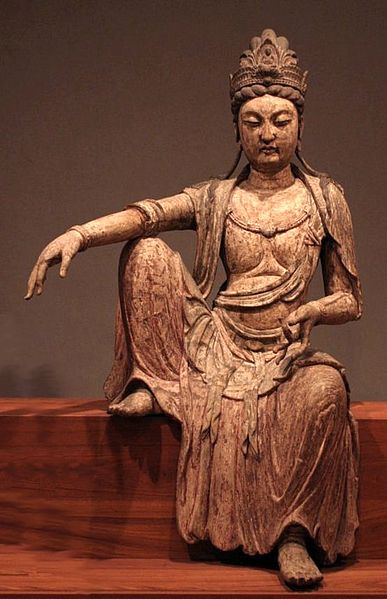
Guanyin

Guanyin is the bhodisattva of compassion.  I love this image for may reasons.  The first is its  grace and beauty.  The ease of the figure is a kind of invitation.  Early forms of the figure are thought to be male, or androgynous. Nevertheless Guanyin is, in this millennium, feminine.  There are many legends about Guanyin (also popularly spelled Kwan Yin), showcasing her generosity and deep desire to help others out of their suffering.

Taking some dharma teaching to heart this past year, I read a bit of buddhist theory and notes on practice and mind training.  I particularly took an interest early on in a book about healing anger through the buddhist practice of patience (written by the Dalai Lama).  This because I’ve rightly been accused of being an angry, or at least often annoyed, woman.  I thought I’d better give equanimity a shot if I wanted to have any friends.

Also, though, as if that weren’t enough, I’ve done this out of an interest in cultivating a calmer, clearer state of mind.  It dawned on me in a moment of profound reflection that nothing I could do to alter my situation would change my emotional state.  I had to do that from the inside out.  So I set off in earnest with morning prayers that started out like this:

Please let me have clarity and happiness today.  I take refuge in the buddha, the dharma (teachings) and the community of buddhist monks until I achieve a state of enlightenment.

I know that is absolutely hysterical – all the more if you know me and my general state of grumpiness.  But there you are.

The prayers progressed to entreaties like this one:

Please let me have compassion today let me Really understand compassion.  And let me have compassion for myself, too.

I found it surprisingly effective.  I actually felt compassion for people I do not like because they are antagonistic to others.  I didn’t like them any better, but I felt compassion for their meanness, realizing it couldn’t be any fun to be so mean, and I felt surprisingly liberated from my negative feelings about them.  In fact, I got hooked on buddhism because the days I started with these reflections turned out to be so much more pleasant than the days I didn’t.

I’ve studied buddhism in the past and always admired its good sense.  But this is something else – a connection with it – that I hadn’t felt before.  I think this has arisen out of a kind of readiness to release some notion I had of cultivating control in my life.  Somewhere along the line I worked out I could only have that as an internal state and not an external one.  And I started working on accepting that.  I am still working on accepting that.  And so having put one foot on the path I’ll say good night so that I can meditate. Who knows?  Maybe I’ll see Guanyin in my dreams.

4 Comments

Filed under Uncategorized

The Seventh Sister – Available on Amazon, and soon, Kindle.

Well, this is exciting. There’ve been a bunch of requests for The Seventh Sister as an ebook, so I will publish it in the kindle format as well, soon. Here is a link to where you can find the print book (always my favorite) on Amazon:

3 Comments

Filed under Uncategorized

mercury is direct again

hooray! we can move forward again!

I notice during mercury retrograde that things stand stiller and I have to go over old ground. it feels a little like being asked to fix an answer I got wrong the first time before moving on.

Leave a comment

Filed under Uncategorized

The Seventh Sister is Available on CreateSpace

Finally! I’m excited to report that The Seventh Sister is ready!
https://www.createspace.com/3835298
Not to be confused with another book bearing the same title – this one is much better, I’m sure!- My title will also be available on Amazon soon.

Leave a comment

Filed under Uncategorized

A changing of the guard.

Once again we come to our celebration of fertility.  Bulbs are popping and the world seems shiny and new.  At least that is how my 7 year-old describes it:  Shiny.

For my part, I agree.  The sun in the sky is stronger, the whirling, cotton forms of clouds don’t conceal its glow for long, they can only cast shadows before fleeing hurriedly south.  The buds on the trees welcome the sun’s return and there are sprays of forsythia everywhere.  Dread old man winter is gone. At least for now.

As if we were standing smartly before the gates of Buckingham at 11:30 sharp, we are treated to a changing of the guard. 

Out marches the hoary, frozen old grump.  And in his place comes to stand the young, shining, flower clad spring maiden.  All is made new.  To celebrate, we color eggs, take walks, plan gardens and summer trips, take in the sight of emerging spring flowers, venture out for dinner in bare legs and raincoats … in other words, we perform her rituals. 

Tonight when I came home I was greeted by a robin, the early bird, and a mourning dove keeping company like old friends in the yard under a blossoming cherry tree, the sun still above the tree line behind them.   They seemed plump, satisfied with their prospects, relaxed and occupied with whatever they were turning up there under the tree.  Worms?  Seeds?  Whatever they find – they are welcome dinner guests. 

1 Comment

Filed under Uncategorized

35.

35.

In November, a deposition was scheduled in Manchester, where our insurance company’s lawyer had his office.  My father and I were required to attend.  Marc drove me home, taking time from his classes to be with me for what we both expected would be a difficult day.

We drove in silence for a while, before he asked me if I’d seen Celeste.  I hadn’t told him about the appearance of Lizzie’s ghost in the library, but he knew that the dream was still bothering me.

“I saw her the other day,” I answered.  There was no inflection in my voice, no invitation to ask any questions or to continue the discussion.

But he did, anyway.

“How was that?”

“Oh, horrible.”

“Is she okay?”

“No.  Not really.”

He made a face.  “It’ll take time, I guess.”

“It’ll take more than that,” I said, a note of defiance in my voice.

He raised an eyebrow.  “Did you tell her about your dream?” he asked.

“Yes.”

“And?”

“She wouldn’t confirm or deny,” I said, my voice and expression distant.  I gazed out the window, remembering my promise to Celeste.  I couldn’t say anything about our conversation.  At least not now.  But it was hard to keep it to myself.  I wanted to tell him.  I wanted to share it.  It was a burden, and together with the loss of my friend I was having trouble shouldering it on my own.  I was having trouble understanding how I was just coming upon something so important, so devastating, now.  After her death.  After months without her. Just learning about it now.

But no, I couldn’t tell Marc yet.  I wouldn’t be able to face Celeste again if I did.

“Hmm,” he said, turning the car left to follow another route.  “Well, you’ll be seeing Mr. Verdano soon.  Maybe you can ask him.”  His sarcasm wasn’t lost on me, but I didn’t make an answer.  I was too numb to be pithy or sarcastic.  Too numb to talk around the truth.

Because it would just come out in a stream.

What Celeste had said.

Yes.

Yes, he did it.

She admitted it.

My father and I arrived at the lawyer’s office the next morning early.  We found two lawyers, a stenographer, some other men wearing suits who presumably represented the insurance company, the Verdanos, and ourselves.  All together, we filled a very long, very impressive-looking table completely.  In fact, the stenographer barely fit into the room with her equipment.

Wow, I thought.  What a crowd.  All there to listen to me and Dad talk.  A lot of money riding on our memories and the words we were about to utter.   I sat down nervously.  Dad sat next to me, businesslike, his expression wary.  He was flexing the muscles in his jaw.

The sight of Mr. Verdano was a jolt.  I kept remembering him in my dream, his pants around his legs.  It was hard to look at him.  But it was also hard not to.  It wasn’t the first time I noticed he was a very handsome man.  This I realized grudgingly and with annoyance.  He was very handsome and had a certain magnetism to him that was undeniable.  He was tall and dark, the possessor of a very penetrating gaze, which, at that moment, he turned and fastened on me.

Realizing we were staring at each other, I looked away, going red, despite myself.  My heart was thumping in my chest.  So strange, the effect he could have on people.  I didn’t want to risk catching anyone else’s gaze, so I looked at the table.  It was shiny dark wood covered with glass.  There were no comfort items present.  No flowers.  Not even dusty fake flowers.  No little bowls of candy.  No glasses of water.  No food.  In fact, it smelled suspiciously devoid of foodstuff there.  Even coffee.  I couldn’t smell coffee.  I thought that was strange.  Didn’t these people eat or drink?  Perhaps only outside of the office.  Or maybe they didn’t have feelings, didn’t get hungry.

The art on the walls was all repro pastel landscapes and cityscapes.  No character, no impact to it.  Just something to break up a wall papered in beige textured paper.  I imagined the office administrative assistant had gone to a local discount department store at lunch one day to buy them.

A woman dressed in a skirted suit and sensible low-heeled pumps came in with some files, and gave them to one of the lawyers.  He didn’t thank her.  Her navy suit was unattractive, and I thought, looking at her, that I’d sooner die than become like her after I finished college.   Boring, permed hairstyle.  Pantyhose.  Content to work in an office where they didn’t have coffee and she had to wear ugly, low heeled pumps.

She left.

I was sorry.  That meant the only other woman in the room, other than the stenographer, was Mrs. Verdano.  I was surrounded by older men, and it made me feel vulnerable and awkward.  I felt they would try to use my words for their own ends and this was frightening to me.

I peered toward the other end of the room.

The table was at least twelve feet long.  The lawyers at the other end sat next to the Verdanos.  They wore dark suits over soft, overweight bodies, were cleanly shaven, had hair that was cut short and combed back.  They were looking through legal-size files, pulling out pens briskly, talking quietly.

I wondered what Lizzie, the Lizzie I’d known in life, would say about this whole thing.  My brain tried to recall her, make her present here with me.  Imagine some clever remark she might make, or even just conjure her smile.  But in this serious, sterile setting she seemed a million miles away and I could not summon a memory to comfort me.  I did not want to think of the ghost or wonder if she could hear the proceedings.  Not now.

I cleared my throat loudly.

“Could I have a glass of water, please?” I asked.

It was as if a gunshot had sounded in the room.  Everyone looked at me, startled.  I needed to get out of the seat they’d assigned me.  The lawyer who apparently presided over the office looked annoyed.  He nodded, waving his hand toward the door and got up to show me out.  I felt clumsy following him, but satisfied that I had aggravated him.

“Dad, would you like a glass of water?” I asked, looking at my father.

He nodded, saying “Yes, thank you Rowan.”

Dad watched us leave, jaw still flexing.  I could hear his breathing.  Deep, steady breaths.  Measured.  His hands were folded in front of him on the table.

His tension made me nervous.  I wanted to reassure him; but of course, I couldn’t think of anything useful to say.  And I didn’t want any of the suits to hear me say anything personal to my father.

When I sat back down with my water, I summoned the courage to look at the Verdanos again.

Mrs. Verdano was sitting demurely, her eyes averted from the other people at the table.  Her blonde hair was tastefully pulled back and fastened against the nape of her neck.  She wore champagne colored eye shadow under her eyebrows which made her eyes look bright and attractive.  A flat gold choker-style necklace under a very flattering champagne colored suit accentuated her slim, attractive figure.  I gazed at her for a moment, letting everything I’d learned about her from Celeste sink in, blend with the woman that sat at the other end of the table from me.  Briefly, my mind went to a memory I had of her visiting Lizzie during a work shift one day at the beach early last summer.  I’d had the day off and was lounging near Lizzie’s lifeguard station when Mrs. Verdano appeared on the sand wearing a business suit and pantyhose, anxious to speak privately with Lizzie.  Her skin looked pale and humid.  Puffy.  Like risen dough on a warm day.  She spoke in a hushed voice to Lizzie, her expression anxious and tearful.  I was out of earshot, but I could see that Lizzie’s response was impatient.  After a few minutes Mrs. Verdano seemed satisfied and checked her watch. She came by the spot I was occupying to say hello politely before leaving the beach, her shoes in her hands, sand no doubt working its way into the fabric of her pantyhose and between her toes.

The memory made a sharp contrast to the picture of composure she presented there in the lawyer’s office the day of the deposition.

After Mrs. Verdano left the beach I asked Lizzie if everything was alright.  She’d hesitated noticeably before telling me that everything was fine.  That her mom had a nervous condition that sometimes required treatment.  I hadn’t thought much of it then, but I wondered who was responsible for treating her condition?  Her husband?

Seated comfortably next to his wife, Mr. Verdano was at ease, dressed in a white shirt and tie, his dark hair neatly combed back, cufflinks shining on his shirt cuffs.  His attention was fixed on one of the uninteresting pictures on the wall.  That was fascinating to me, since Lizzie had often told me her father liked to collect art, frequently attending estate auctions and art openings.  Surely most anything else in the room would have been a more interesting object for his attention.  I looked at his hands, folded together, resting on the table in front of him.  He wore a gold wedding band, and I noticed for the first time how carefully cared-for his hands were.  His nails looked as if they had been manicured, buffed.  I stared.  I’d never seen hands like that before.

“Well, I think we can get started, now,” one of the lawyers said.  He motioned to the stenographer, who nodded.  “We’re here taking depositions from Mr. Thomson and his daughter Rowan this morning, on November first, nineteen ninety,” he said.  The stenographer began to click click click at her machine.

The lawyer looked at my father, his hands resting on the table before him.  “Mr. Thomson, we’ll start with you.  I’m going to ask some questions.  Some of them may seem repetitive.  Try to bear with me.  We want to be as precise as we can.”

My father nodded.

“We’ll start with how the car arrived on your property.  Could you please tell us what happened?”

My father cleared his throat.  “Yes.  Our daughter Rowan was frequently in Lizzie’s car.  Often, Lizzie drove them to school in the morning.  At that time, I asked her if she was maintaining the car properly because it was an old model with over a hundred thousand miles on it.  Naturally I was concerned for their safety,” he paused there, taking a sip of his water.

“So when she told me she had never changed the oil in the car, I was concerned.  I offered to do that for her, since I do the same for all of our family’s cars.  It’s always been a hobby of mine to work on cars,” he added.  “She brought the car over and I changed the oil for her.”

It is our understanding that you agreed to do work on the car for Ms. Verdano,” the lawyer said.  “What, exactly, did you do to the car?”

I didn’t like the tone of that question.  His use of the word “to” suggested my father had damaged the car.  I glared at him.

“I didn’t do anything to the car, sir,” my father’s voice was steady.  “I simply changed the oil in the car and changed the brake pads.”  He took a deep breath, regarding the lawyer with his steely blue-gray eyes.

“Thank you,” the lawyer said shortly.  The rest of the questioning continued that way, detailing the extent of my father’s access to her car, which in the end was just to change the oil and brake pads once.  We established that no less than four times.  A half hour later the lawyers seemed satisfied that my father had changed the oil and the brake pads once, with Ms. Verdano’s full permission and knowledge.

We further established that I had been in the car with Lizzie both before and after my father had done the work.  This fact was established three times that I counted.              Fascinating, I thought sarcastically.

By the time they were finished questioning my father my annoyance level was matched only by my boredom.  What a waste of a day.

The lawyers finally turned to me after an hour and a half of asking my father the same questions fifty different ways.

“Are you going to ask me the same questions over and over again, as well?” I asked, disdain evident in my voice.

The lawyer smiled.  “No, Rowan.  We’ll try to keep our questions to you succinct and to the point.”

Phew.  That was a relief.

“Are you ready to begin?  Would you like another glass of water?”

“Yes, please,” I answered, anxious to get up.

I went out into the office and pushed the little blue cold water tab down.  I waited, taking deep breaths and trying to relax.  I disliked that lawyer.  I disliked his questions, his tone, all of it.  I disliked his charcoal gray pinstripe suit and the dandruff that I noticed was collecting on his shoulders.

When I reentered the room everyone sat waiting in the same positions they’d been in when I left.  Was this what happened as people got older?  Did they fossilize?  Or was it just lawyers?

Not everyone in the group was suspended like that.  The Verdanos stood out despite their subdued presentation.  Mr. Verdano leaned toward his wife, his manner languid, the subtlest expression of pleasure there.  He said something to her that I could see pleased her.  The trace of a smile visited her lips and she blushed slightly, looking down at her lap.  Had he said something amusing?  Something suggestive?

My hate for Mr. Verdano rose up into my throat and spilled, sour, into the back of my mouth.   The feeling I had was like nothing I’d ever felt.  A visceral, animal hate for him.  I hated his self-confidence, his devastating good looks, his self-possession.  I knew he was cruel.  I hated him for disguising it.  I wanted to lunge across the table onto him, strangle him, stab him, bite him.  Destroy him.  The intensity of it made me dizzy.  I closed my eyes and took a deep breath, trying to control myself.

When I opened my eyes, nothing had changed.  I hated the idea of having to say anything, share a single memory, a single exchange, in front of the Verdanos.

“So, Rowan, we’re going to begin.” The lawyer nodded to the stenographer, who began to click away.  “We’re speaking with Rowan Thomson, November first, nineteen ninety.”

A pause.  “Rowan, what time did Lizzie leave your house?”

“She usually left around 9:30,” I answered non-committally, glaring at him.

“You think that Lizzie left your house at 9:30?”

“About that,” I answered.

“And where was she going?”

I could have sworn the table started to shake then. The whole room started to shake.  I looked at my glass of water.  Still.  Maybe I was shaking.

“She said she was going to work,” I said, resenting his questions.  Resenting the Verdanos.  Resenting the beige room and shiny table.  Pissed off, actually, and getting angrier by the moment.

I looked at the Verdanos, sitting placidly at the end of the table.  Well fuck them, I thought.

“She said she’d had an argument with her mother,” I added in an aggressive tone of voice.  I glared at Mrs. Verdano.  She looked surprised, hurt.  I wondered if she looked that way because I’d said something damaging or because I’d brought up a painful memory.

“Okay.  Well let’s stick with where Lizzie was going.  She was going to work.  Anywhere else?  Any stops on the way?”

“Not that she talked about.  Her shift at the lake would have been starting within a half hour, so I don’t know where else she would’ve gone other than to a gas station or convenience store,” I said.  “You know, the accident took place on her way to the lake, right?  So why are you asking me these—forgive me—stupid questions?”  I was letting my anger spill over into my voice, onto the table, into the air, and it was getting the best of me.

Carrying me away in a stream of poison.

This was probably a bad idea.

But it was too late, and nobody had given me the choice.  The lawyer didn’t call the house and say “Do you think Rowan would mind talking to us?  Giving a deposition?  Would she be comfortable with that?  Do you think she’d like to give us her version of the day’s events privately?  Would that be easier?”  I smiled at the ridiculous nature of my fantasy.  The thought of these lawyers respecting my feelings was ridiculous.

This added fuel to the fire that was threatening to blow the room up.

I leaned forward.  “You know, she wanted to be a nurse,” I said, glaring at the lawyer.

Dad touched my arm, took a sharp breath in.

Too late.

“A nurse!” I added, a laugh escaping.  “Imagine that.  She wanted to help people, even with a father that abused her.”

There.  I’d said it.

No going back now.  I glared at Mr. Verdano.  “Sexually abused her, as a matter of fact.”  I added, a laugh that sounded both spiteful and hysterical erupting.

Out of control.

I wanted to make him react.  But he sat there composed, cold, a trace of a smile there on his handsome face.  He looked at me, held me there with his eyes like a rag doll.  Looking almost as if he was amused with my outburst, but certainly not rising to my accusation.  I glared vainly.  Ineffectually.  Bored, he dropped me with his eyes and turned his gaze on the lawyers, his expression indicating he didn’t have any idea where I could have gotten such an absurd idea.

The lawyer cleared his throat.

I looked at Mrs. Verdano.  She was white.

“Rowan, I understand this is difficult for you, but please, let’s try to stick with the events of that day, okay?”

“Difficult?” I asked, my voice rising.  “Difficult?  You understand this has been difficult for me?  I don’t think you understand anything.”

I knew I sounded juvenile and out of control but I couldn’t help it.  I had to say these things.

The lawyers exchanged looks, eyebrows twitched.  Suited rear ends shifted in their seats.  Glasses were adjusted.  I looked at Dad, who was regarding me with something like interest, cautious fascination, even.

“Okay.”  The lawyer kept a calm exterior but I could see he was becoming upset.  By my impertinence?

It was too much to hope that my accusation had upset any of the cadavers at the table.  If they had responses to what I’d said, nothing was evident on their faces.  Except for Mrs. Verdano’s.  She looked like she was about to faint.

“Rowan, can we continue?” the lawyer asked, his annoyance seeping out now.

“Sure.  Fire away,” I said, getting comfortable with the tone I’d adopted and pleased to be punishing Mrs. Verdano in whatever small way I could.

My voice in the deposition would reflect the truth of my situation.  If they didn’t like it, they could spend some more money and reschedule their precious deposition.

“So Lizzie was going to work at the lake,” he parroted again.  “And when she drove away, did you notice anything unusual about the car?”

“Yeah, the wheel was wobbling wildly.  I yelled ‘Hey, Lizzie!  I think your wheel’s come loose!’  She said, ‘No worries, Rowan, I’m going to have that fixed this afternoon!’”  I finished, my voice alternating between a strained attempt to keep from crying and hysterical laughter.

I was trying, but I couldn’t control my voice or my expressions.  Looking at Mr. Verdano only made it worse, made me feel more desperate in my hate and desire to expose him.

The lawyer put his pen down and sat back in his chair, bringing his arms up to the back of his head.  The other lawyers looked at him.  “Ms. Thomson, this is a serious matter.  Jokes are not appropriate here.  If you can’t answer the questions then we will simply reschedule the deposition for a time that is more,” he paused, clearing his throat, “conducive to a productive outcome,” he finished.

“Sure thing.  Whatever works for you guys,” I said, the pitch in my voice continuing to rise, my expression a tight attempt to keep my laughter in check.

“I’m all about productive outcomes.  Rowan Productive Outcome Thomson.  See?  My middle name.”

Now Dad’s concern registered on his face.

“And while you’re at it, why don’t you depose Mr. Verdano?  Ask him how many underage nurses it takes to blow a sick psychiatrist?”

Dad went white.  But he didn’t say anything.  He just flexed his jaw, his eyes roaming from my face to the faces of the lawyers and back again.

“Let’s take a break,” the lawyer said, getting up and walking out.

I put my head down on the shiny table.

It was cold.

Everyone stood and walked past me.  I could feel them looking at the back of my head as they passed by me on their way out of the room.  I was embarrassed, self-conscious.  And I felt sorry for my father, who was undoubtedly embarrassed by my bizarre display.  I kept my head down, not daring to look at him.

Dad sat there beside me, drumming his fingers on the table.

“Honey, you’re scaring me,” he said after a few minutes.  “Do you think maybe you should talk to someone?  A psychiatrist, maybe?”

I raised my head, leaving tears on my arm and the table.  “Sure.  Why don’t we institutionalize me?  Then we could dispense with the bad jokes and hysterical behavior.” I didn’t look at him when I said that, because I knew he wanted to help me and didn’t deserve to be talked to that way.

But it was really my best answer.  I didn’t have any other response to that question in that moment.  The irony that he’d suggested I go to a psychiatrist — the very thing that Mr. Verdano did for a living — was not lost on me.

We sat silently there, together.

Finally the lawyers all filed back into the room.  Followed by the Verdanos.  Haggard now, I looked at my nemesis.  He returned my gaze comfortably, an eyebrow raised, a gesture of greeting on his face.

Red.  A veil of red descended on the room.  I nearly went wild with frustration at the sight of his face, digging my nails into the flesh of my palms to keep from screaming.

The lawyer that had been questioning me did not pick up his pen when he took his seat.  He still had dandruff on his shoulders and his suit looked rumpled.  Didn’t he have a secretary to tell him he was snowing on his shoulder?  I thought cruelly.  I contemplated pointing it out to him, feeling vicious.

He sat down, leaning on the table.  “We think, perhaps, we can do without any further testimony from Rowan,” he said, sounding tired.  “We realize this has been very traumatic for you,” he said, looking at me, “and we believe that we can settle this matter with the information we have.  Would that be acceptable to everyone?” he asked, looking around the table.

I nodded, relieved to be released.

Neither of the Verdanos gestured in any way, but the lawyers all nodded their agreement.

We were free to go.

When we stepped outside, the year’s first dusting of snow had fallen.  The lawyer’s office was on a hill.  We stood on his brick stoop and looked over the calm white quiet magic of the snow.  Powdery, swirling in some places.

We stood looking.

Dad buttoned his coat, pulled his lapels up against the cold and put his hands in his pockets.

“First snow,” he said.

I looked at our feet, side by side on the stoop.  No other footprints leading in or out of the office.  We would be the first footprints in the snow.

“Yup.  Pretty.” I sniffed.

He looked at me.  “Are you okay, Rowan?”

“Yup.”  Nope.

He put his hand on my back in a gesture of help and reassurance and we stepped off of the stoop together into the snow.

Dad did not ask me about what I had said.  I didn’t know why.  And I didn’t bring it up again.  That night at dinner we all tried to make light conversation.  Kori was quiet, and Billy tried to make a joke.

“How many Texas Aggies does it take to screw in a light bulb?” he asked.

I groaned.

Mom grinned.

Dad answered.  “Four, son.  One to hold it and three to spin him around.”

Billy smiled, clearly pleased with himself.

Inevitably, though, the conversation turned to the day’s main event: the deposition and its possible outcome.

Kori asked the question.  “Will Mr. Verdano get a lot of money?”

“Possibly,” Dad said, chewing.  “He could get the extent of our homeowner’s policy, which is about a half a million dollars.”

I thought that over.  In light of what I had learned about Mr. Verdano and his family it seemed beyond criminal.  The thought made my throat start to tighten again.  I pushed myself back from the table, feeling sick.

Everyone was watching me.  I couldn’t hold back my tears.  They came in a river.  It was too much for me to hold onto.  “It’s wrong, so wrong,” I said, my chest heaving up and down with the effort of controlling myself.

“Oh, sweetheart,” Mom got up and came around the table to hold me.

“No.  You don’t know what happened.  You don’t understand.” I said, the tears blurring my vision and what I was trying to say.  I felt like an erupting volcano, anger oozing everywhere.  I couldn’t articulate.

They were silent, watching and listening.

“He … ” I burst into a fit of crying that completely obscured my words.  I burbled a bit, trying to speak, and couldn’t.

They waited.

“He was abusing her.” I finally spat, shaking my head and clenching my fists.

“You said that today,” My father said, putting his fork down and folding his hands calmly.  “Where do you get the idea that Mr. Verdano was abusing Lizzie?”

Taking deep breaths to regain myself, I glared at Dad.  It wasn’t that I was directing my anger at him, but it was spilling out.  Everyone sat silently staring at me.  Billy’s food was on his fork in mid-air, suspended there.

“I had a dream about it.  I went to see Celeste, to see if it was true.” I said, trying to affect some calm, through clenched teeth. My nose was running, and there were little paths where the tears were making their way over my cheeks.

“She said it was.  True.”

Everyone’s jaws hung open, stunned.

“Oh, God,” my father said, leaning back in his chair to rest his head against the wall behind him. From there he looked at me, his expression registering a mix of disgust and pain.

In a flash, the image of Lizzie’s ghost came back.  The grip of the vision jolted me, a realization slamming into me.  At the launch.  He.  Look what he did to me.  He, he, he. Could it be?

I jumped up and ran from the room, pursued by the ghost.

Leave a comment

Filed under The Seventh Sister, Uncategorized

34.

Note to readers:  The main character’s name has been changed for publication (to protect the innocent 😉

34.


I have a memory of Lizzie dancing.  We were hanging out in our family room, talking about school, boys, vacation plans.  She had brought the new Madonna album with her, and we were listening to it on the stereo.  She jumped up and started to dance around, singing along with the song, her hair flying wildly as she spun around and around, wiggling to the Spanish rhythm.  Saying she couldn’t stand to have me sit there and watch her, she pulled me up off the sofa to join her.

She did that sort of thing whenever the mood struck her, sometimes while she was driving.  Holding onto the steering wheel with both hands, she would bounce up and down or wiggle back and forth in her seat, singing along with the music.

Or just walking along, wherever we were, at the beach or on our way to school, she would dance.  Being so openly happy, so often, really wasn’t normal, I told myself.

And there was something else:  She never had anything unkind to say about anyone.  That, also, was surprising and seemed abnormal.  I didn’t know anyone else, again, including myself, who didn’t indulge in a little mean-spirited gossip now and then.  I never really understood that about her.  Always happy, never a mean thing to say.

I compared my schoolmate with the apparition I saw on the boat launch, of the girl whose father had violated her.  The intensity of her ghost was not like my school friend.  I compared the Lizzie I remembered to the dreams I’d been having, to Celeste’s description.  But it was hard to compare an apparition that made her own sister feel threatened to the Lizzie I had known.

Somehow, I couldn’t accept that dying had made my happy friend unhappy.  And where had she found the strength to go through life as if everything was all right when it wasn’t?

I lay in my bed thinking of her, a book covering my face.  I groaned, a renewed realization of her physical absence sweeping over me.

“You all right?

I took the book off of my face, annoyed at the interruption.  One of my classmates, a girl named Sue, stood inside the door looking like perhaps she was somewhere she wasn’t sure she should be.

“Sort of,” I said.  “What can I do for you?”

“I just wondered if you had finished your Astronomy homework.  I’m having some trouble with it.”

I laughed.

Homework.  I hadn’t put much energy into that so far this semester.  Even an earnest attempt to do research for Food and People had come to nothing when Lizzie’s ghost appeared in the stacks.

“Uh, no.  I can’t say I’ve even looked at the assignment.  When’s it due?”

“Tomorrow,” she said, shifting on her feet and looking around.  “Well, sorry to bother you.  I guess I’ll see if I can find someone who’s looked at it,” she turned and left.

I put my book back over my face, resuming my brooding state.

A mother who chose not to protect her children: that aspect alone, Mrs. Verdano’s unexplainable choice to allow her daughters’ continued abuse, was more than I could understand and made me very angry.  Even if Mrs. Verdano was medicated, how could she do this?  And Lizzie’s super-human ability to disguise the situation …I was sure there was some psychological model that would explain all of this, but I couldn’t recollect a single memory of anything Lizzie had said or done that would have clued me into the bizarre picture that was emerging of the Verdano family.  How was it all possible?

It seemed to me that I had never really known Lizzie.

My mind returned to Mrs. Verdano.  Bake sale volunteer, flower shop owner.  She always bought the most stylish clothes and jewelry for her girls, always looked elegant herself.  I had jokingly called her the PTO queen.  She’d never missed a meeting.  She’d also never had a spare moment for any of us.  It seemed to me that perhaps she was always busy as a means of avoiding what was happening at home.  Had she used her many business and volunteer commitments as a kind of shield?  A means of removing herself from something she could not or would not deal with?  Why?  Was Mr. Verdano so important to her, did she feel so invested in that relationship that she would sacrifice her daughters to it?

And her father.  Polished, sophisticated, charming.  All of Lizzie’s friends harbored little crushes on him.  An Italian-American from New York, he’d graduated from an Ivy League school and ran the psychiatry department at Manchester Hospital.  He was well-known in our little community, well-respected.  Had even donated a room to our local library.  As I contemplated him, though, I realized that part of his mystique and appeal had always been a kind of smoldering mysteriousness.  He was never available to anyone I knew for anything more than the most casual, passing conversation and cordialities.  Even at social functions he chose to attend, he rarely appeared on time, preferring instead to arrive late enough to avoid introductions and idle chatter.  Unless he was a benefactor or speaker.  At those events he shone.  All generosity and humility.

I thought about school ball games.  Celeste had been a cheerleader for the football team.  I hadn’t thought much about it before, but if memory served correctly, he often disappeared early from games.  I remembered Mrs. Verdano and the girls getting into her car on their own; Mr. Verdano’s Mercedes was almost always gone by the time the rest of us reached the parking lot.  Still, my parents had always considered the Verdanos friendly acquaintances.  And now he was filing a lawsuit for wrongful death against my father.  It seemed like a work of fiction too surreal to be believed.

I tensed again as the image of the ghost, an image that was always there, burned into my mind.  The vision of her apparition visited me over and over again, causing my heart to leap.  Always accompanied by her words.

Look what he did.

Breathing consciously, listening to the very real physical event of air rushing into my body and then out again against the book still lying on my face, and doing it a second time, noticing the pages flapping during my second out breath, I thought about being halfway though the semester.

Lizzie would have been halfway through her Biology class and the Food and People class I was enrolled in.  Probably the sight of fat deposits wouldn’t have made her throw up, and it was a safe bet that she would be earning good grades.  She’d always been an honors student.

Most likely, I wouldn’t have been lying there with a book on my face if she’d come to school with me.

I reflected.

And I certainly would have been earning at least passable grades as well, if things had been different.  I hoped.

Probably, she would have made a habit of dancing around our dorm room with a Madonna album playing.   And, she most certainly wouldn’t have let the badly intentioned Steve drag me, sick, out of a fraternity party and up a set of stairs.


Leave a comment

Filed under The Seventh Sister, Uncategorized